• Skip to primary navigation
  • Skip to main content

← cbs.dk

CBDS

CBDS

Business in Development Studies

  • Home
  • Blogs
    • Corporate Social Responsibility
    • Critical Debates
    • Entrepreneurship 
    • Global Value Chains
    • Green Transition
    • Industrialization
    • Humanitarianism
  • Podcasts
  • Contact
  • Show Search
Hide Search

Uncategorized

Radiance in the Temple: The Mass of Las Auténticas and the Indigenous Disobedience of the Gender Binary

30 December 2025

By Jacobo Ramírez

Juchitán de Zaragoza, November 16, 2025

I grew up hearing that the Isthmus of Tehuantepec is a land of strong winds and even stronger wills. That idea always felt true, but only in recent years have I understood that this strength lives not only in the Zapotec history of territorial defense: it also lives in the bodies and lives of those who challenge, every day, the limits imposed by coloniality. Among them are the muxes.

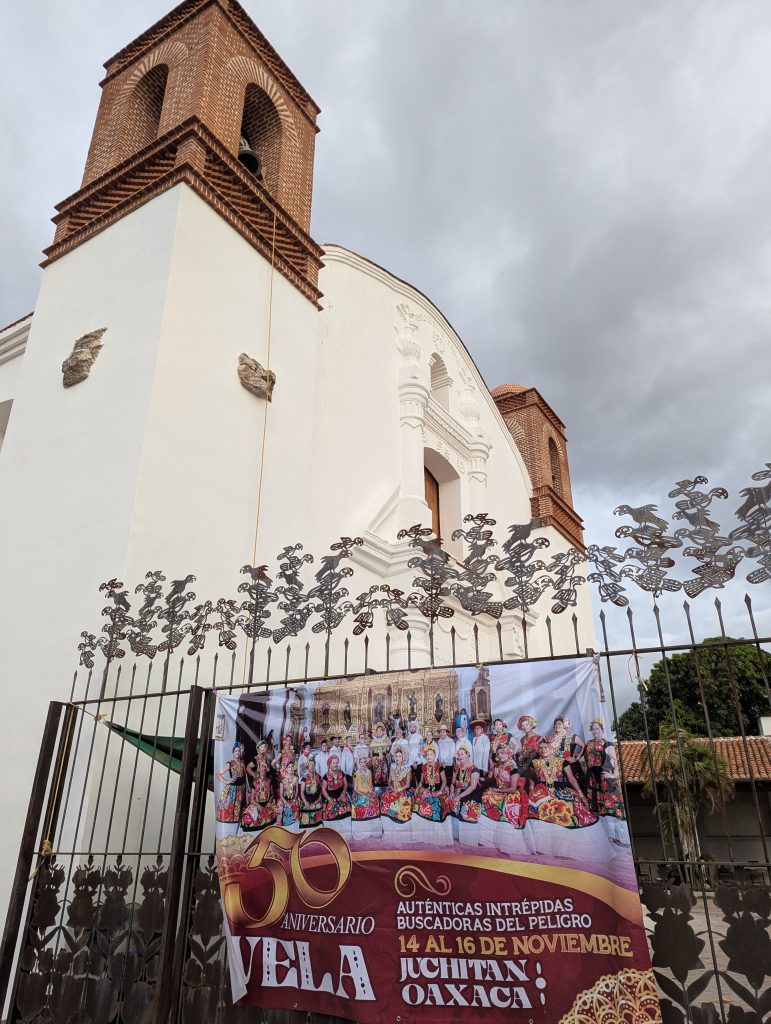
When I arrived in Juchitán to accompany the 50th anniversary of Las Auténticas Intrépidas Buscadoras del Peligro, I understood that muxeidad is not just an identity category: it is a way of walking through the world, grounded in relationships with community, memory, ritual, and territory. Muxes inhabit a social and spiritual space shaped by Zapotec cosmology and by the colonial wounds that attempted to silence the gender plurality that existed long before evangelization.

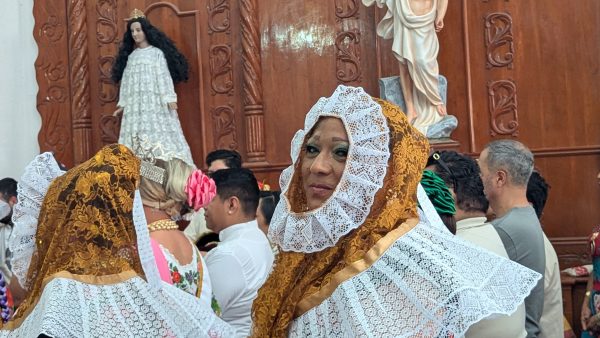
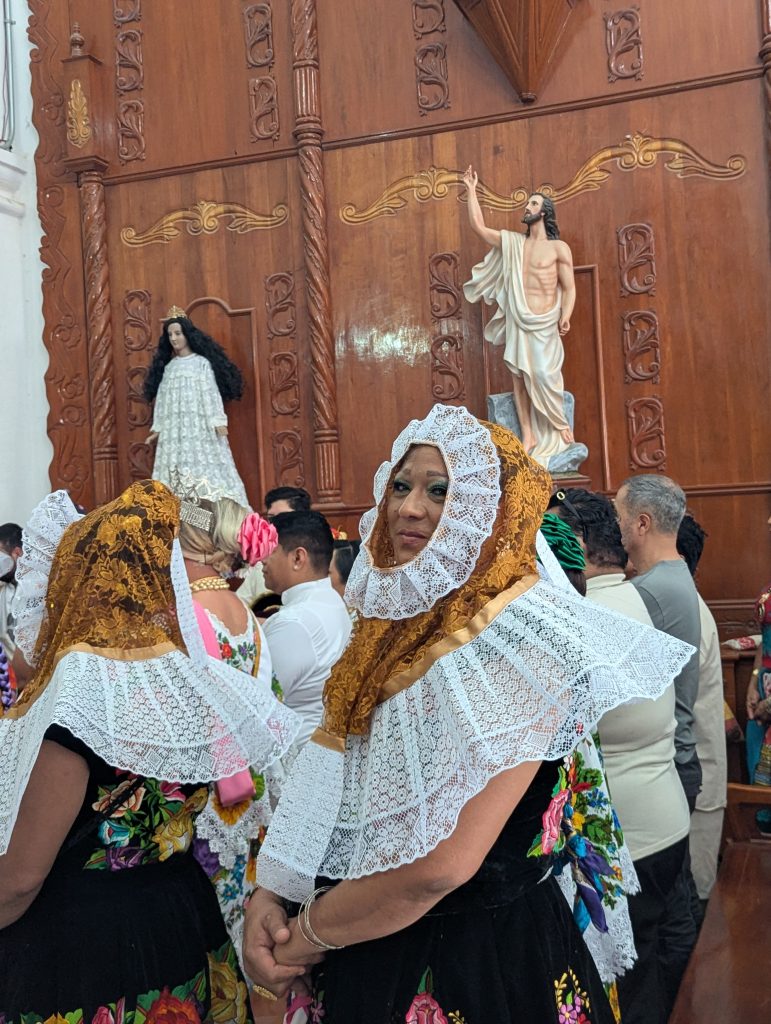
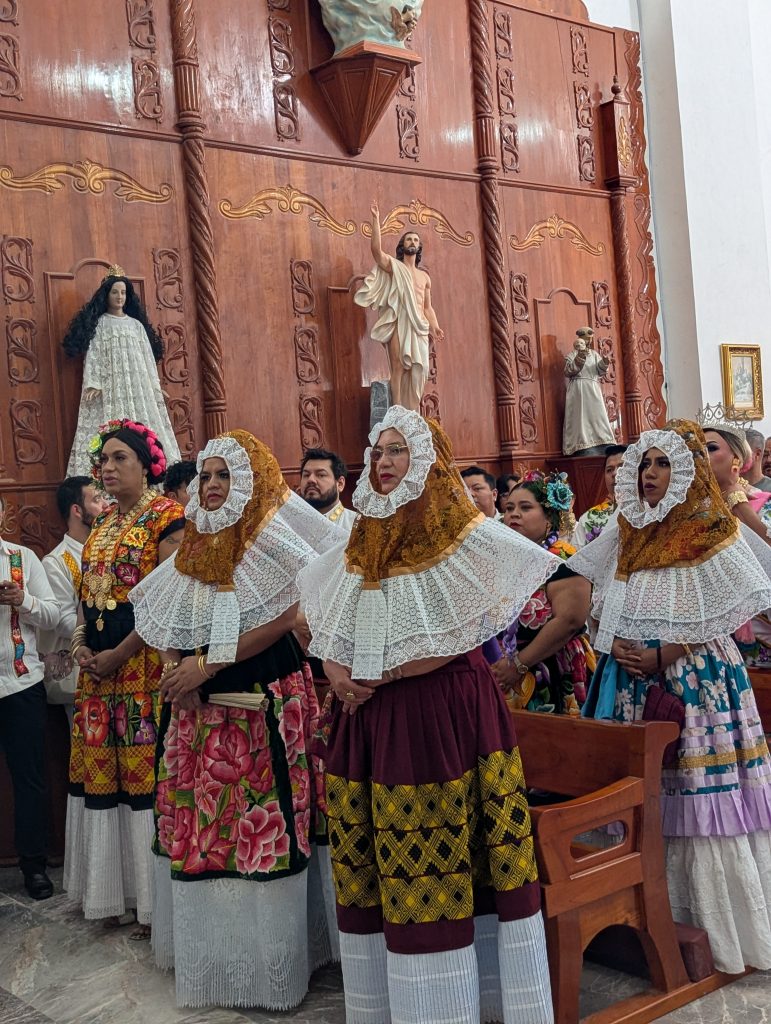
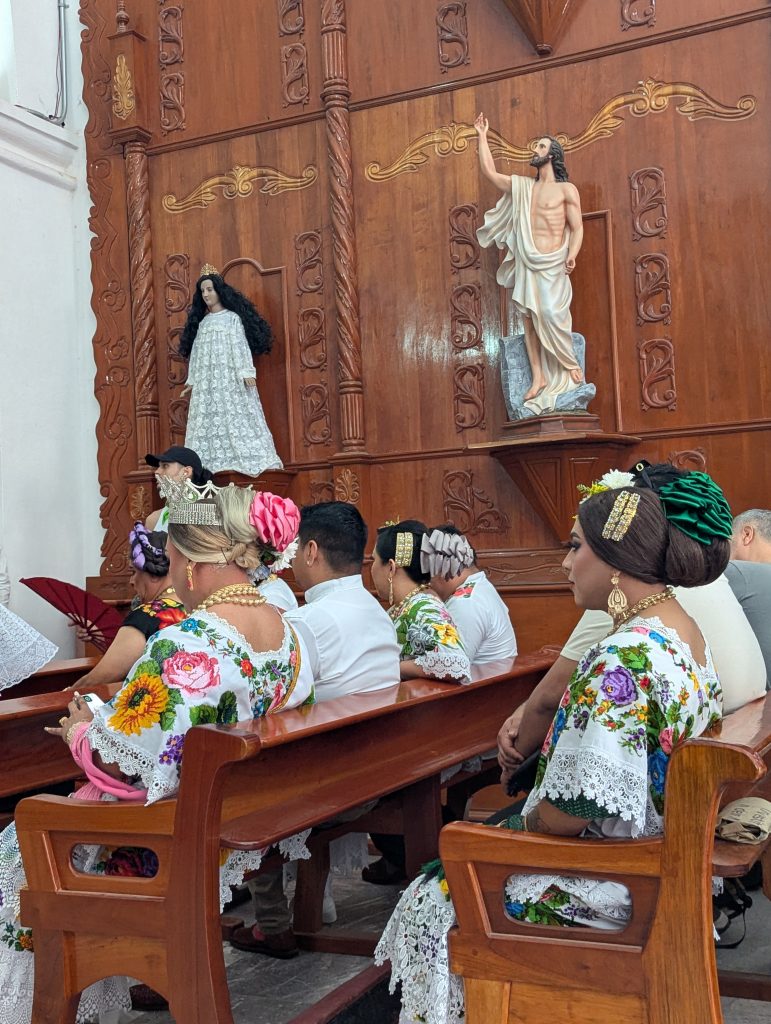
Anthropological records speak of Aztec priests who wore clothing associated with another sex, Maya deities with multiple bodies, and ritual figures embodying duality and fertility. But those references, useful as they are, do not capture what it feels like to stand inside the church of San Vicente Ferrer and watch the muxes enter in their Tehuana dresses, carrying resplandores that illuminate centuries of resistance.

On that November 16th, as I watched them walk in, I realized I was witnessing something nearly impossible anywhere else in the world: a formal Catholic ritual dedicated explicitly to a third-gender community. An improbable gesture within the canon of a Church that has historically policed bodies and disciplined difference. Yet in Juchitán – as in so many Indigenous territories – imposition was never total. Here, Catholic faith was negotiated, reinterpreted, resisted, and at times transformed from within.

As the muxes advanced down the central aisle, accompanied by Maya representatives from Yucatán who also belong to Mesoamerican non-binary gender traditions, I felt history fold onto itself. It was as if precolonial traces and colonial wounds touched for a brief moment, revealing the persistence of worlds that never disappeared.

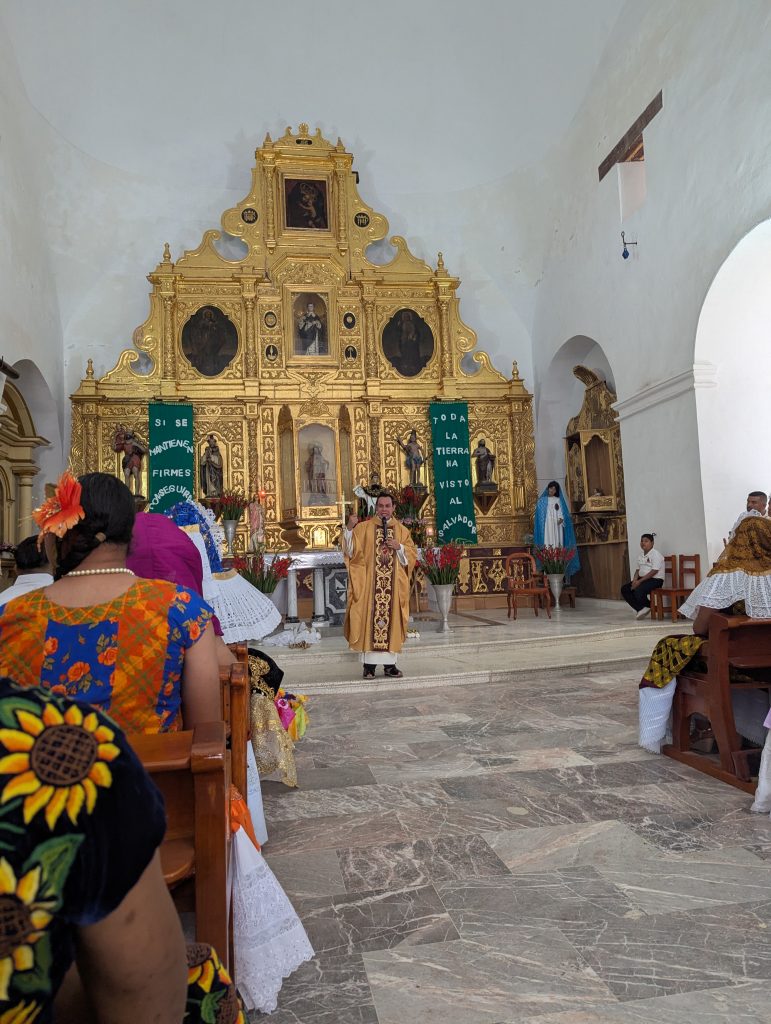
The priest spoke of justice, perseverance, and peace. He evoked the parable of the widow who insists before an indifferent judge, reminding us that those who seek justice often find doors closed. I heard his sermon not only as a spiritual message but as a living metaphor for what it means to be muxe in a country where gender, violence, and inequality intersect daily. At that altar, the Bible and everyday life seemed to speak to each other as equals.

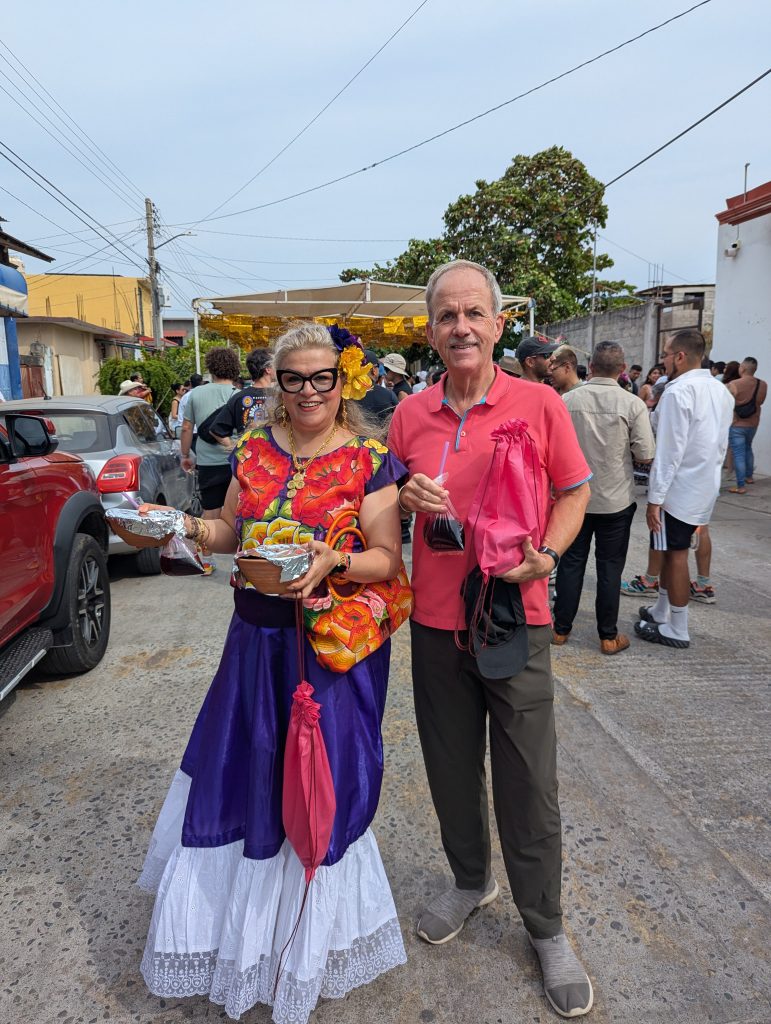
After the Mass, a local band accompanied the procession toward the mayordoma’s home. The streets of Juchitán filled with music, sones, laughter, and steaming Oaxacan mole served in deep clay bowls. We were also offered fresh hibiscus water, and, as tradition holds, we gave a cash donation to the mayordoma – a communal gesture that reminds us that every celebration, every vela is sustained by an economy of care, daily labor, and collective commitment.

From my anthropological perspective, but also from my position as a person with Isthmus roots – child of parents born in this territory – returning to learn, I understood the political depth of that ritual. What happened that afternoon was not simply a Mass: it was a declaration. A statement that Indigenous worlds persist beyond attempts at colonial normalization. A living expression of ontological plurality. A bodily and spiritual resistance to the imposed gender binary.

For centuries, muxes have sustained community life in the Isthmus: they organize velas, care for their families, work in the markets, and keep alive the affective and ritual networks that uphold Zapotec existence. They are central to social reproduction, though their contributions rarely fit the economic and administrative categories defined by the State. Their labor is relational, situated, vital, and deeply feminized. And like so many forms of feminized labor, it is profoundly undervalued.

This Mass, this crossing of the Indigenous and the Catholic, of colonial wounds and everyday creativity, illuminates the contradictions that muxes inhabit without seeking to resolve them. From within ambivalence, they transform the systems that once excluded them. Through the aesthetic work of the body, they weave historical continuity. From the margins, they open futures.

I remember walking behind the procession, thinking about the way muxe testimonies overflow any fixed category. They do not seek to explain an identity; they assert a presence: they exist from within a world where ritual, care, and resistance are deeply intertwined. They told me – between laughter, makeup, pain, memories, and pride – that being muxe cannot be translated into Western categories; it is a relationship, a mode of community-making, a way of sustaining social life in the face of persistent coloniality.

This blog emerges from that moment: from a Mass that not only celebrated fifty years of history but revealed a continuity far older. From the understanding that muxes are neither folkloric symbols nor tourist postcards: they are living testimony of how Indigenous peoples create worlds at the margins, reinvent what they inherit, and challenge what was imposed upon them.

It is in that territory – fractured, vibrant, contradictory, and profoundly human – that the testimonies I share here are born. Each one is a situated intervention, a form of future-making that pushes its way through the winds of the Isthmus.

Final Note

The photographs included in this blog were taken by me, in an effort to capture not only the moments but also the strength and presence of those who made this celebration possible. Everyone portrayed granted verbal consent for the publication of these images, which aim to honor their stories and their journeys.

I extend my deep gratitude to Felina Santiago Valdivieso, Kika Godínez, Amurabi Méndez, Eduardo López Castillo, Patricia Castillo Luna, and Torben Laurén for their accompaniment, their care, and their supportive presence during the Vela of Las Auténticas Intrépidas Buscadoras del Peligro. Their support made possible not only this visual record but also the collective experience that sustains it.

Dr Jacobo Ramírez is an Associate Professor at the Centre for Business and Development Studies (CBDS) at Copenhagen Business School (CBS). His research focuses on organisational strategy in fragile states and other complex institutional environments shaped by security risks, displacement, and social unrest. His current work examines renewable energy investments in emerging markets. A Mexican–Danish dual national, Jacobo was born in Mexico and has lived and worked in Copenhagen since 2006.

Frelimo and the fate of Mozambique: Part 2

23 April 2025

By Pedro Alarcón

The general election of 9 October 2024 in Mozambique triggered a political crisis in which hundreds of Mozambicans have been killed, injured or arrested. This blog post seeks to explain its origins and implications.

This is the second part in a two-part blog post. See the first part on Frelimo and the fate of Mozambique here.  

In early December 2024, during the protests triggered by the 9 October election, a statue of Alberto Chipande was brought down in Pemba, Cabo Delgado’s capital. It is hard to imagine that the crowd was not targeting the image of Frelimo’s strongman and businessman, once a guerrilla combatant, and fifty years later one of the richest people in the country with links to companies that hold interest in the hydrocarbon sector. Joseph Hanlon, who conducted research on Mozambique for around 40 years, argues that young people believed that the 9 October election was an opportunity for change, yet they saw this opportunity cheated. With the lowest life expectancy index of the continent, three out of four Mozambicans are younger than 30 years old. They lived their whole life under Frelimo rule. They are well aware that prestige inside the party opens the gates to success in private business and conspicuous wealth. 

During half a century, Renamo was the challenger, first as a contra guerrilla and then as a political party, exerting formal opposition from the National Parliament. This particular configuration is sometimes referred to as the rule of ‘Frenamo’ to underscore that Renamo was Frelimo’s unpleasant partner in steering national politics (with ups and downs depending on political leverage) and in controlling state businesses (sometimes making their claims with weapons). After all, Afonso Dhlakama, Renamo’s leader, was a member of the Council of State during Guebuza’s presidency. Dhlakama died in 2018 at the age of 65. The government decreed a state funeral with official honors. 

To stay in power, Frelimo co-opted the domestic opposition using the state apparatus as a toolbox. Amidst any threat, the Frelimo elite closed ranks and responded as a block. Frelimo governments secured international aid by embracing the changing socioeconomic and political agendas of multilateral aid institutions and Western governments’ aid agencies, or making these aid agencies believe that they embraced them. A few private fortunes thrived during the half-century, but the living conditions in the country barely improved for the majority. Three-quarters of the 35 million Mozambicans live in poverty, and the figure is growing. Maintaining control over society has been an increasing challenge for Frelimo as elections proved an illusion, and wealth generated by natural resource extractivism serves to keep clientelistic and patronage networks rather than to benefit the majority. Frelimo increasingly bets on state authoritarianism and outright repression.

The 2019 general election was the last election in which Renamo was the second force in parliament after Frelimo. On 23 December 2024, the Constitutional Court ratified Daniel Chapo as the winner of the 9 October presidential election and Frelimo with a majority of seats in Parliament.  Podemos had the second largest amount of seats, with 43 seats out of 250. For the first time since 1994, Renamo was not second. It goes without saying that Podemos’ unexpected electoral success was linked to the support of Venancio Mondlane as a presidential candidate. After the announcement of the Constitutional Court, protests resumed countrywide; between December 23 and January 9, 165 people were killed, 36 more than during the previous ten weeks. 

Venancio Mondlane returned to Maputo from his self-exi le on 10 January. At least three more people were killed while trying to reach airport facilities to take part of a massive reception. The morning of Mondlane’s arrival, the leaders of the political parties met President Nyusi in his office. Hours before, Podemos announced that the party was occupying their seats in parliament, tacitly accepting the results of the election. A setback for Mondlane, he officially broke with Podemos on February 4th in a press release.

Daniel Chapo was sworn in on 15 January amidst street protests in Maputo. Five days before, on the other side of the Atlantic, Nicolás Maduro assumed for the third time the presidency of Venezuela. Maduro’s election was also contested, locally and internationally. Nevertheless, his assumption meant a turning point to five months of fraud allegations, local protests, and demonstrations across all Latin American main cities with large communities of Venezuelan migrants. International pressure also faded. After all, Venezuela is an oil-rich country, and the global North still yearns for fossil fuels despite climate commitments and the rhetoric of a transition towards cleaner energy sources. With the benefit of hindsight, this could also apply to Mozambique. While Maputo awaits with high hopes the resumption of natural gas extraction in Cabo Delgado, President Chapo announces austerity measures to cope with the crisis. Attacks by the Al-Shabab also continue; by mid-2024, more than five thousand people had been killed and more than half-million have been displaced in Cabo Delgado’s third war.

Mass mobilization accompanies Venancio Mondlane in his tour throughout the country. In an interview for a British newspaper, Mondlane declared to have been offered a minister position in the new government, and that he was considering it. Daniel Chapo never denied it. Perhaps things never change: Frelimo’s old strategy of coopting the opposition, as the opposition mobilizes the people to put pressure on the government. 

Indeed, nothing has changed for the majority of Mozambican citizens. Mondlane catalyzed the opposition against Frelimo. In many ways, he unified a fragmented opposition that was found outside the formal political parties. Nevertheless, o povo (the people) was on the verge of a backlash after fifty years of Frelimo’s rule. But it seems it is not enough to alter the Mozambican political landscape. Alternatives must be offered. Alternatives to a democratic politics that maintain clientelist networks and co-opt oppositional forces. Alternatives to natural resource extractivism and rentier state dynamics that benefit few private pockets. Without addressing structural problems, the country will reproduce its history of suffering or, in words of Yussuf Adam, Mozambique might escape the crocodile’s teeth only to fall into the leopard’s mouth (“escapar aos dentes do crocodilo e cair na boca do leopardo”). 

Pedro Alarcón is a Global Forum Democracy and Development (GFDD) research fellow at the Nelson Mandela School of Public Governance of the University of Cape Town. Alarcón has held guest professor positions and fellowships in Europe, Latin America and South Africa. His research lies at the crossroads of climate change, energy, and society. Regions/countries of interest: Southern Africa, Andean countries, the Philippines. https://globalforum.ceu.edu/pedro-alarcon/


Reimagining Multilateral Governance: Integrating Humanitarianism, Development, and Peace in the UN and the Organization of Islamic Cooperation

8 April 2025

By Christina Plesner Volkdal

Amid escalating humanitarian crises, protracted conflicts, and overlapping global disruptions, multilateral institutions are under renewed scrutiny. The demand for more coherent, inclusive, and sustainable responses has propelled the rise of the “Triple Nexus” framework – an integrated approach that seeks to align humanitarian aid, development strategies, and peacebuilding efforts. Yet, translating this framework into institutional reality remains a challenge. A recent series of CBDS policy papers interrogates this challenge through comparative analyses of the United Nations (UN) system and the Organization of Islamic Cooperation (OIC), revealing structural gaps and offering strategic pathways for reform.

The first policy paper examines how six key UN agencies – United Nations Development Programme (UNDP), United Nations High Commissioner for Refugees (UNHCR), World Health Organization (WHO), World Food Programme (WFP), Food and Agriculture Organization (FAO), and International Labour Organization (ILO) – engage with the Triple Nexus framework. While rhetorical alignment exists across the system, implementation remains fragmented. The analysis uncovers significant divergence in governance models, integration capacities, and financing mechanisms. Agencies such as WHO and ILO demonstrate stronger governance coherence, yet still encounter operational bottlenecks. Others, including FAO and WFP, struggle to institutionalize peacebuilding within their sector-specific mandates. The paper argues that political economy constraints – ranging from donor-driven priorities to rigid bureaucratic procedures – undermine Nexus implementation. It recommends a shift toward integrated governance structures, pooled and flexible funding, and localization strategies that prioritize adaptive, context-sensitive programming.

The second paper turns to the OIC, whose humanitarian operations are hampered by fragmented coordination and limited institutional capacity. Despite its reach across 57 member states, the OIC lacks a centralized humanitarian architecture capable of delivering timely, resilient responses. This paper calls for the establishment of an OIC Humanitarian Operations Centre and a regional Disaster Risk Reduction framework. It further proposes the integration of the Triple Nexus as a guiding principle – connecting emergency relief with development financing and peacebuilding mandates. Drawing lessons from the Association of Southeast Asia Nations (ASEAN) and the African Union (AU), the paper emphasizes localized preparedness, digital innovation, and multi-year investment strategies to enhance institutional resilience and programmatic coherence.

The third policy paper critically assesses the OIC’s role in peace and security. Unlike the UN, AU, and the European Union (EU), the OIC lacks a dedicated peace and security infrastructure, relying instead on ad hoc diplomacy and non-binding resolutions. The paper proposes the creation of an OIC Peace and Security Council, a Mediation and Crisis Response Unit, and a Standby Force capable of rapid deployment. It also recommends the establishment of a Peace and Security Fund grounded in Islamic financial instruments such as zakat and sukuk. These institutional reforms, the paper argues, are essential for transforming the OIC from a rhetorical actor into an effective agent of conflict resolution and peacebuilding.

Together, the three policy papers underscore the urgent need for institutional innovation within multilateral systems. Whether at the global level within the UN or the regional level within the OIC, the operationalization of the Triple Nexus remains hindered by structural fragmentation, financing gaps, and insufficient coordination. Addressing these challenges requires more than technocratic adjustment – it demands a political and institutional reimagining of how global governance engages with complexity, crisis, and change.

Christina Plesner Volkdal is a PhD Fellow at Copenhagen Business School, affiliated with the Department of Management, Society, and Communication. With a background in the UN, particularly in humanitarian coordination, and an approach as a participant observer, she leverages first-hand experiences to offer profound insights, enriching her contributions to the field.

Frelimo and the fate of Mozambique

4 April 2025

By Pedro Alarcón

The general election of 9 October 2024 in Mozambique triggered a political crisis in which hundreds of Mozambicans have been killed, injured or arrested. This blog post seeks to explain its origins and implications.

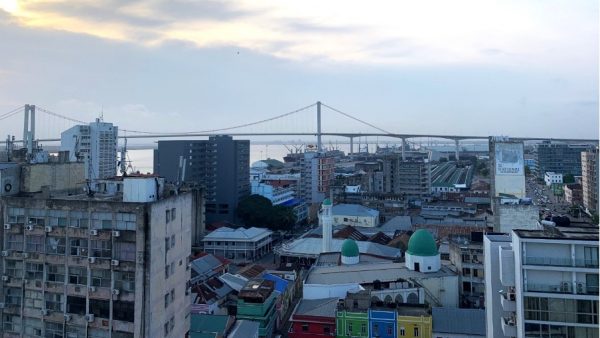
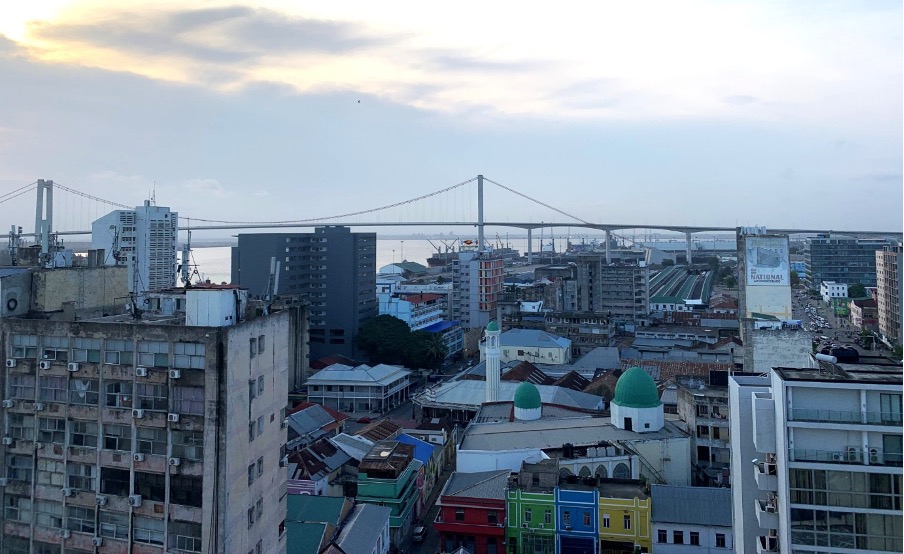
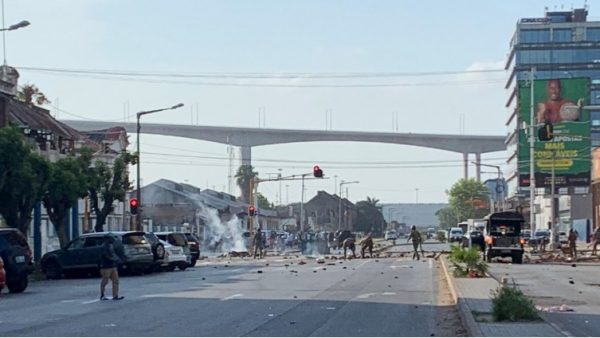
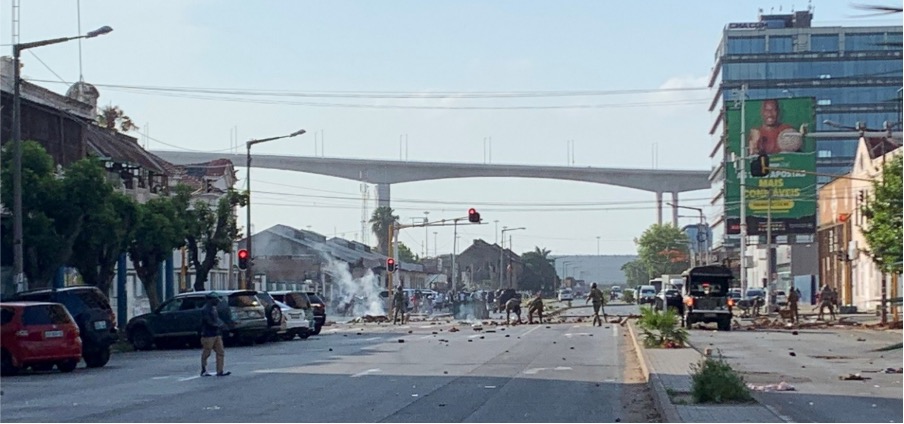
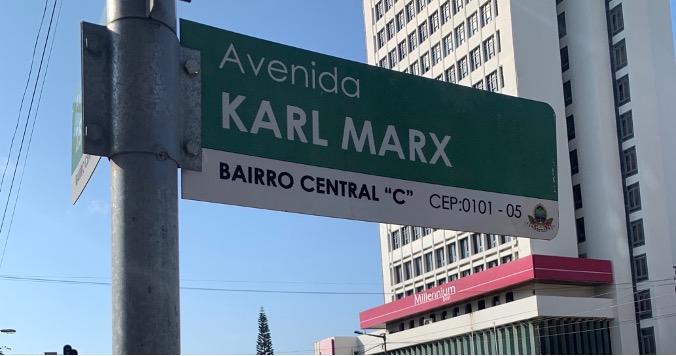
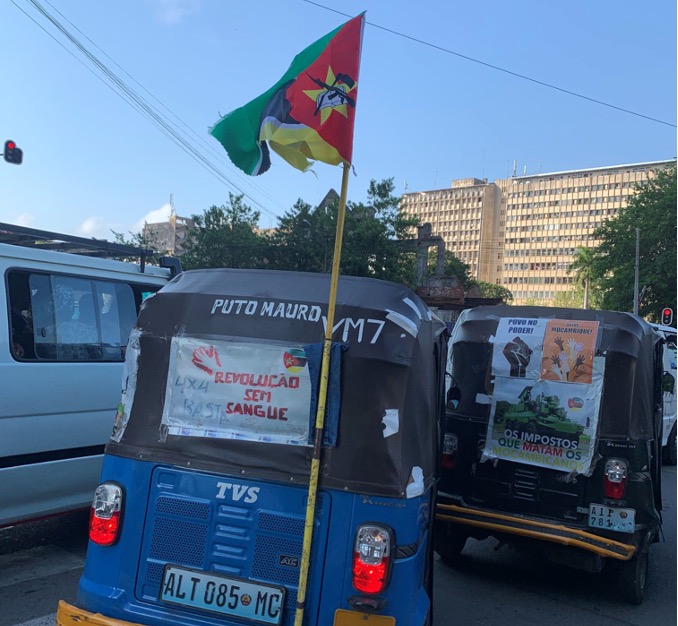
A taxi picks me up at the airport. It has a printed sheet stuck to the windshield: a photo of Venancio Mondlane with the caption povo no poder (people in power). I announce the destination of my trip: 25th September Avenue, downtown Maputo. ‘We’ll get there’, the taxi driver tells me confidently- ‘The protests, you know?’, he comments. I pretend to be unaware of the situation. He explains: ‘Venancio wants to be president’. ‘Will he be?’, I ask. ‘No’, he answers. ‘Frelimo is strong’. It is past four in the afternoon. Along Karl Marx Avenue we hear vuvuzelas. On 25th September Avenue cars with slogans like povo no poder, salve Moçambique (save Mozambique), or simply basta! honk their horns. Three blocks away policemen clear a barricade, smells of tear gas. Kids sell vuvuzelas.

It is mid-December 2024; ten weeks have passed since the 9 October general election. The National Electoral Commission declared Frelimo’s presidential candidate, Daniel Chapo, the winner by a large majority. The Mozambique Liberation Front (Frelimo) has ruled the country since 1975, first as a single party and after 1994 winning all electoral processes. Since then, there has been a crescendo of allegations of fraud. The European Union Election Observation Mission denounced blatant irregularities in the last election. Venancio Mondlane, an independent candidate supported by the party Optimistic People for the Development of Mozambique (Podemos) alleged fraud and declared himself the victor. From abroad, he called for protests. Days after the election, Mondlane’s lawyer, who was preparing to challenge the official results, and a Podemos spokesman were assassinated. Protests mushroomed across the country, resulting in the deaths of at least 130 people by mid-December, and more than 345 people shot and 3,600 arrested. 

In trying to understand the crisis, I do not consider Mozambique as an isolated case. After all, 2024 was a watershed for the liberation movements that became ruling parties in the southern part of the African continent. In the May 2024 general election in South Africa, Nelson Mandela’s African National Congress lost the parliamentary majority for the first time since 1994. In October 2024, the Botswana Democratic Party lost control of the government for the first time since independence in 1966. In December 2024, Namibia’s SWAPO, which has been in power since independence in 1990, managed to retain the presidency despite the worst election result in its history. Will Mozambique be the exception? To shed some light on the question, I delve into the country’s contemporary political economy. 

Official history tells that the liberation war began on 25 September 1964, when Alberto Chipande fired the first shots of the Frelimo guerrilla. Ten years later, the guerrilla emerged victorious and became the government of the nascent People’s Republic of Mozambique in 1975. Alberto Chipande was appointed Minister of Defense under the presidency of Samora Machel. The challenges of the new government were enormous: to guide the Mozambican society towards the construction of a project of modernity and national unity from a colonial past of suffering and segregation. The single party became the central tool to strengthen the state institutions and consolidate the government in power. Modernity came by hand of a state that intervened directly in economy and society. To achieve national unity, the state also had to respond to society’s needs of self-determination and cultural integrity and guarantee human and political rights.

Land, banking, industry, and businesses of all sizes abandoned by retornado Portuguese were nationalized. While investments were made in public education, health and infrastructure, the homem novo (new man) became common parlance. Elísio Macamo argues that a basic principle of Mozambican politics has been the notion that “individual liberty is a function of a national political project, and not necessarily inherent to the individuals themselves” or their rights. Methods of re-education, collective execution and punishment were not unusual. Benedito Luís Machava argues that re-education and labor camps were considered by Frelimo leaders as essential to the construction of the morality of the homem novo.

During its Third Congress in 1977, Frelimo declared itself a Marxist-Leninist Party. The national anthem, ¡Viva, Viva Frelimo!, promised that the homeland would be the tomb of capitalism and exploitation. But roads are never straight. Mozambique became one of those places where the Cold War was not cold. Apartheid South Africa and Rhodesia promptly built an army to remove Frelimo from government: the Mozambican National Resistance (Renamo).

The Mozambican civil war lasted 16 years. David Robinson estimates that while the war killed about one hundred thousand people, another one million lost their lives because of war’s effects such as famine. Five million Mozambicans were forced to become refugees. Renamo destroyed schools, health posts, bridges, and electricity infrastructure to undermine Frelimo’s popular support. In 1982, Mozambique defaulted external debt. Bretton Woods institutions started to claim key arenas in social and economic planning. 

Samora Machel was killed in a plane crash in South Africa in 1986. Frelimo appointed Joaquim Chissano as his successor. The first structural adjustment program was drawn up when Machel was still alive. For Frelimo, neoliberal reform was a strategy to secure international aid. The recipe of the so-called Economic Rehabilitation Program did not differ much from the reforms prescribed to other countries defaulting on their external debt, notably Mexico, Brazil, Argentina, the Philippines. In addition to the elimination of controlled prices, devaluations and an aggressive privatization program, the Mozambican recipe had a special ingredient. To seal the exit from socialism, a class of local capitalists had to be created.

Reform opened the gates for the transference of state resources to private pockets. Whereas larger industries went to foreign companies, medium and small businesses were transferred to individual members of the Frelimo party elite. International cooperation encouraged corruption. Joseph Hanlon argues that already by 1988 donors funded loans to the unexperienced businessmen of the Frelimo party elite with no intention that the loans would be repaid. Other misappropriations of public funds followed through the recently privatized banking system. 

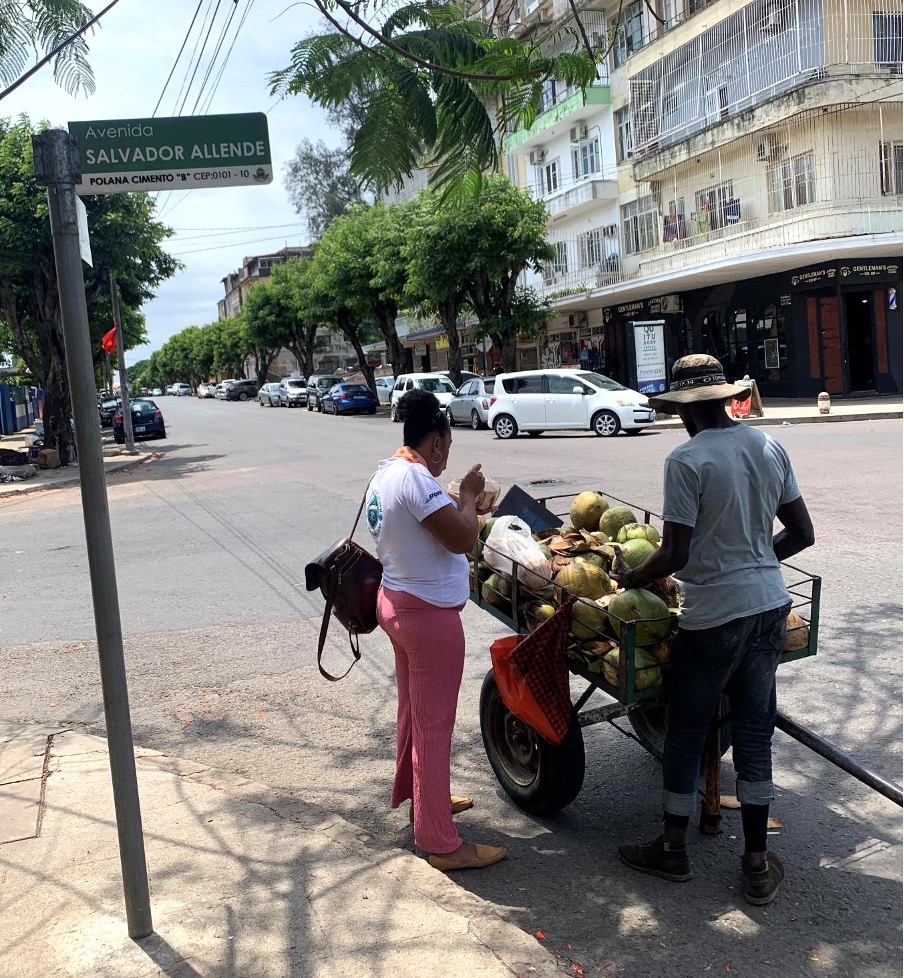
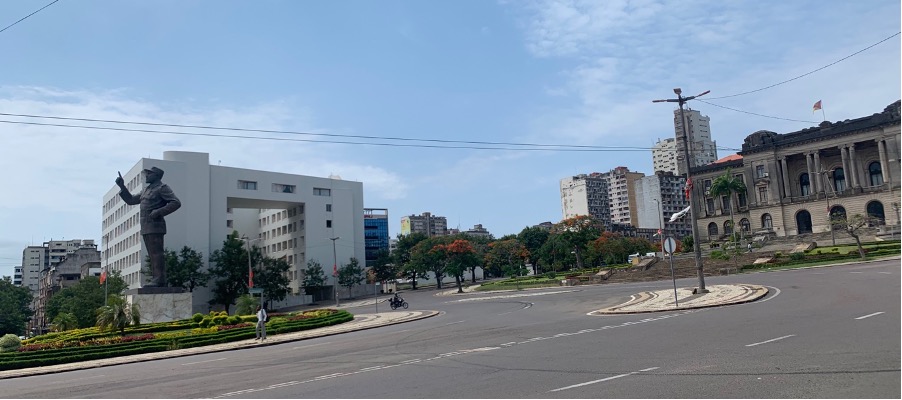
The 1990 Constitution was meant to settle the transition of the socialist state towards a market economy and from the single party system to a liberal democracy through multi-partyism and elections. With the falling of the Berlin Wall, the civil war ended with the Rome Peace Accords of 1992. Frelimo’s candidate and acting president Chissano won the 1994 election against Renamo’s leader Afonso Dhlakama. With the entering into force of the constitution, the country became the Republic of Mozambique. Marxist rhetoric was removed from state parlance. Street names in Maputo recall a remote socialist dream.

During Chissano’s period (1986-2005), development aid accounted for more than fifty percent of the state budget. The government was more accountable to donors than to society. In 1999, Chissano was reelected with a narrow margin against Dhlakama. Nevertheless, Renamo became the principal oppositional force in the Assembleia da República(National Parliament) with enough leverage to demand a limited flow of state resources to benefit its leading members. 

When Frelimo’s Armando Guebuza won the 2004 election against Renamo’s Dhlakama, Alberto Chipande was already a successful businessman with his enterprises receiving (and not repaying) loans funded by state resources. Joseph Hanlon and Theresa Smart recap that by 2005, a company linked to Chipande had repaid 82 percent of its loan, whereas a company linked to President Guebuza had actually repaid only one percent. Alberto Chipande was appointed member of the Council of State, a four member-body created by Guebuza himself to advise the president. According to José Jaime Macuane, Lars Buur and Celso Marcos Monjane, during Guebuza’s period (2005-2015), the available economic opportunities were distributed among inner circle members. 

The personal trajectory of Alberto Chipande illustrates the metamorphosis of Frelimo and the fate of Mozambique: a guerrilla combatant turned into a high-ranking government official and then into a business mogul with a say in national politics. Many analysts highlight the fact that Chipande’s support was key to the election of Filipe Nyusi as successor of Armando Guebuza within Frelimo, and also for his victory in the 2014 presidential election against Dhlakama. Chipande and Nyusi are native of the Northern province of Cabo Delgado, where Chipande holds interest in many investments, including the hydrocarbon sector. 

Frelimo turned from a mainly rural guerrilla into the single governing Marxist party during the civil war, to the democrats overseeing neoliberal reforms—with practically the same people in charge. Furthermore, the government was central to turn the country into the “donor darling” by strategically complying with the changing requisites of Bretton Woods institutions and Western aid donors. Using the aid machinery and the whole state apparatus to their benefit, Frelimo controls politics and national businesses. 

The massive discovery of natural resources during the second decade of the twenty-first century—coal in the central province of Tete and natural gas in Cabo Delgado—translated into a period of fast economic growth driven by foreign direct investment. For the Frelimo elite, relying on coal and gas extractivism meant the possibility of ceasing dependence on international aid. The prospects for increased revenues stimulated the expansion of public debt, including a two-billion-dollar deal secretly sealed by Guebuza for purchasing military and surveillance equipment. Following the ‘hidden debt’ scandal, Bretton Woods institutions suspended their support to the state budget. Natural gas revenues did not flow as expected, and the country sunk in deep economic recession. There is no sign of light at the end of the tunnel.

Crisis is the hallmark of the administration of Filipe Nyusi (2015-2025). Frelimo’s attempt to switch from international aid rents towards rents generated by natural resource extractivism failed. Joao Feijó and Aslak Orre recap that extractivism in Mozambique has been historically instigated by foreign investment but invariably carried out with local rentier elites. Emblematic for Mozambique is the fact that the state grants tax incentives and ensures public guarantees for private debt to attract foreign direct investment and make extractive projects financially viable for domestic capitalists. In words of Carlos Nuno Castel-Branco, the Mozambican state gives away strategic natural resources at low cost. 

Cabo Delgado is the textbook case of extractivism within Mozambique. The historically “cursed” region by its abundance in natural resources experiences a boom of extractivism for more than a decade. Deposits of natural gas were discovered in 2010 and graphite begun to be extracted by multinational companies in 2017. Graphite is used in batteries and solar panels; hence, its demand is expected to rise as the energy transition advances in the Global North.

High expectations of access to increased natural resource rents and “creeping authoritarianism” precipitated the resumption of the armed conflict with Renamo in 2013. A new peace accord was signed in 2019. By the time peace talks were under way, in 2017, a new war emerged in Cabo Delgado: the third war. Cabo Delgado was the main site of the liberation war. The Mueda Massacre (Northwest of Cabo Delgado), where the Portuguese fired on a crowd demonstrating for independence in 1960, was central to the establishment and consolidation of the Frelimo guerrilla. Cabo Delgado was also a battlefield of the civil war. The region witnessed a high percentage of the total casualties.

Violence made it to the international news when Al-Shabab (the youth) militias attacked the town of Palma in March 2021. Palma served as a base of operations for French TotalEnergies in the construction of a liquefied natural gas plant aimed at facilitating the transportation of Mozambican gas to Europe. The attack resulted in more than one thousand people killed including dozens of contractors. TotalEnergies halted the construction of the plant. Tacitly admitting that it could not provide protection for foreign investment, the Mozambican government turned for military help to the Southern African Mission in Mozambique of the Southern Africa Development Community and to Rwandan armed forces, as a result of an agreement with France and Rwanda.

In an effort to shed light on the origins and the persistence of the third war in Cabo Delgado, Liazzat Bonate, Paolo Israel and Carmeliza Rosario argue that international jihadism became linked with local grievances such as poverty and unemployment and perceived discrimination, exclusion and state violence linked to religious and ethnic identities. In trying to regain control of the territory, the Mozambican armed forces have committed human right violations. Attacks of Al-Shabab continue in Cabo Delgado. The return of TotalEnergies through the provision of a pacified territory seems like another empty promise at the end of Nyusi’s administration.

This historical perspective describes the structural conditions that frame the stage in which the current political crisis takes place and might or might not be solved. It underscores the configuration that regulates the relationship between state and society through state’s allocation of rent generated by natural resource extractivism. In general, rentier politics creates clientelist and patronage networks with sectors of society and co-opts oppositional forces, which might explain Frelimo’s electoral success. In particular, the Mozambican rentier state benefits local elites by transferring state resources to private pockets. 

Pedro Alarcón is a Global Forum Democracy and Development (GFDD) research fellow at the Nelson Mandela School of Public Governance of the University of Cape Town. Alarcón has held guest professor positions and fellowships in Europe, Latin America and South Africa. His research lies at the crossroads of climate change, energy, and society. Regions/countries of interest: Southern Africa, Andean countries, the Philippines
https://globalforum.ceu.edu/pedro-alarcon/

Southern African Garment endeavors and impressions’ – Part 1: The lives of managers – Southern African cross-border manufacturing operations in times of lockdowns

13 February 2025

By Andries Bezuidenhout and Søren Jeppesen

A factory in Eswatini, with a notice board of the Eswatini Investment Promotions Authority (EIPA)

The location of garment factories in Southern Africa is often determined by boundaries between countries and the implications that these boundaries have for labour markets. Many of these garment manufacturers are from Asia – especially Taiwan – who locate their operations in Southern Africa to take advantage of the Africa Growth and Opportunities Act (AGOA) of the US, which provides access to the US market as development strategy.

Of course, the future of this “trade, not aid” strategy and its contribution to the US’s soft power is uncertain, due to the new Trump administration – but this is a story for another day (or blog).

Nevertheless, since the early 1990s, several well-established South African owned garment manufacturing operations have also been relocated to both Eswatini (formerly called Swaziland) and Lesotho.

One advantage of this is that workers in the two countries fall under different labour regimes, with much lower minimum wages. Since both Eswatini and Lesotho are part of the Southern African Customs Union (SACU), clothes manufactured in the two countries are not subject to import tariffs when imported back into South Africa, which remains the main market of these firms.

So, in theory, goods can flow freely across the borders between South Africa and its two smaller neighbours. An unforeseen event, of course, was the Covid-19 pandemic, which led to these borders being shut down.

Our travels to visit these factories and to understand how these varying labour regimes play out in practice have led us to make a number of ethnographic observations about the lives of the South African managers of these factories.

The road to the Maputsoe industrial park in Lesotho – it illustrates the rural setting of garment manufacturing here

A first observation to make is that, whilst the manufacturing operations of these companies are now mainly located in Eswatini and Lesotho, their marketing and management arms are still in South Africa’s main urban centres of Johannesburg and Durban. This means that there is constant regional travel between these urban centres and the two neighbouring countries.

In South African terms, Eswatini is driving distance from Johannesburg – you can drive there in a morning, cross the border, and get to the factory with ease. South African managers who run the manufacturing operations (as opposed to marketing and distribution) often relocate their families to Eswatini and typically live in a place called Ezulwini.

Ezulwini (translates to English as “heaven”) is in a valley between two mountain ranges. There are hotels that housed the casinos which were frequented by South Africans at the time of apartheid, when gambling was illegal in South Africa.

More recently, thought, a smart shopping complex called “The Gables” was constructed, housing South African coffee shop franchises (Mugg & Bean), shops, and even a 3D cinema. The complex’s style – its gables – refer to Cape Dutch architecture, a style of colonial South African architecture characteristic of wine estates in the Western Cape.

Eswatini’s garment factories are mostly located in Matsapha, which is a short drive from Ezulwini, and managers can easily move between their residential estates in Ezulwini and Manzini’s industrial district.

Eswatini also has a number of elite private schools, notably Waterford, of which the actor Richard E Grant is an alumnus – an additional advantage for South African managers and their families.

Controversially, Eswatini is a monarchy and notorious for the repression of political dissent from both labour and human rights activists. Policing – even traffic policing – is quite visible and the country has a reputation of being a safe place, that is as long as you don’t challenge the regime. For South Africans from crime-ridden Johannesburg, this could also seem like an advantage.

Our observations are that South African managers running operations in Lesotho follow a different strategy. Lesotho is further from South Africa’s main urban centres – it would take a whole day to drive from Johannesburg or Durban to there. Also, the factories here are in a town called Maputsoe, which is less spectacular than the misty mountains of the Ezulwini valley in Eswatini.

However, the main industrial area in Lesotho, Maputsoe, has the advantage of being right next to the South African border and a town there called Ficksburg. The latter is known as a hub of cherry farming, it has quaint coffee shops and road stalls, as well as established middle class schools and suburbs.

The Eastern Free State, where Ficksburg is located, is known to have beautiful mountain ranges and attracts tourists from the country’s urban centres – notably to a town called Clarens, as well as Rosendal, a small town close to Ficksburg where several well-known South African visual artists reside.

The South African managers of garment manufacturing operations in Lesotho have mostly made homes for themselves in these towns on the border of Lesotho, but still in South Africa. Those who live in the South African town of Ficksburg can cross the border between the two countries on a daily basis with relative ease – a special permit makes this even easier, since they don’t have to go through daily customs checks.

This was until Covid-19 hit.

Interestingly enough, because the South African managers in Eswatini lived in the country, they were able to maintain a presence at their factories. Some switched to the manufacturing of protective gear, such as face masks, but textile supply lines from China were severely disrupted. Also, the South African border was closed for a certain time.

Tragically though, and within the broader context of massive suffering during the pandemic, a prominent South African manager contracted Covid and was not allowed to cross the border into South Africa to seek medical attention. He died of the disease.

In Lesotho, the majority of the South African managers were not able to cross the border into Lesotho to run their operations. However, it turned out that their Basotho colleagues were quite able to manage without them. They had contact on web-based platforms and over the telephone, but when the lockdown ended, and despite disruptions in textile supply lines, these companies recovered quite quickly.

Our main focus here is an ethnographic description of how South African managers decide to run their operations in neighbouring countries, but we have to mention here that the upshot of the Covid-19 pandemic and the lockdown was that there was a reinforcement of regional production networks. It led to a revival of the sourcing of textiles from Southern African manufacturers and garment producers in Eswatini and Lesotho that had previously exported exclusively to the US, redirected some of their orders to the South African market.

But that is also a story for another day (or blog).

By Andries Bezuidenhout, Professor, Department of Sociology, Anthropology and Development Studies, University of Fort Hare, South Africa and Søren Jeppesen, Associate Professor, CBDS, MSC, CBS

  • Page 1
  • Page 2
  • Go to Next Page »

Copyright © 2026 · Copenhagen Business School

  • Accessibility Statement
  • Privacy Policy
  • Cookies